
Emulated controller
Your PLC program runs unchanged in an emulated controller (for Siemens S7-1500, PLCSIM Advanced) on our test systems, so we test the code that will run on site.
Industries: Agriculture, Automotive, Baggage Handling, Warehousing
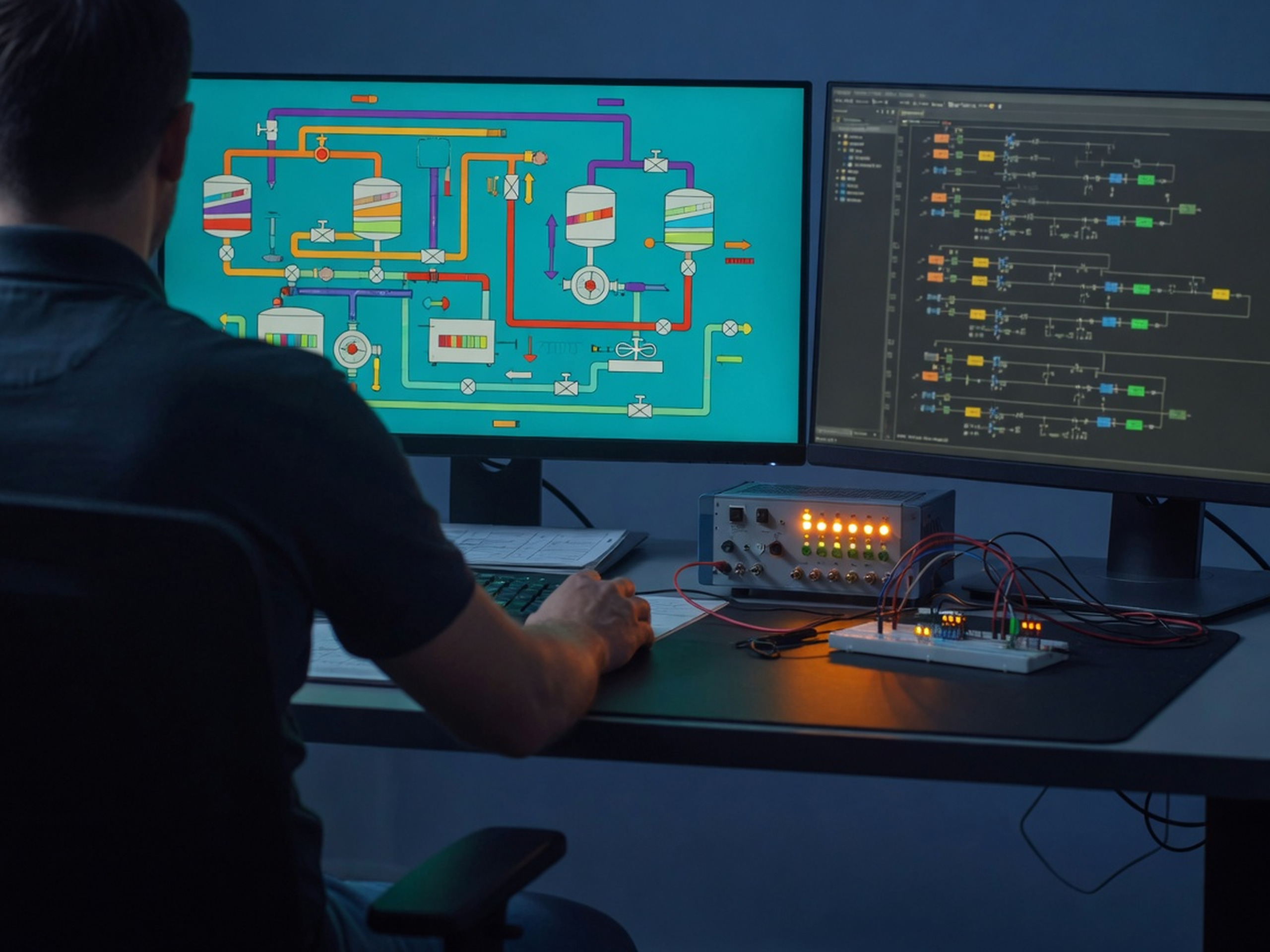
Virtual commissioning
Your real PLC program, proven against a simulated plant, long before site.
Sound familiar?
Site commissioning is the most expensive place to find a mistake. Crews wait, production waits, and logic gets fixed under pressure on live equipment. Virtual commissioning moves most of that work earlier: the real control program runs against a simulated plant, so sequences, interlocks and screens are proven before anyone travels.
How it works
We run your actual PLC program in an emulated controller and connect it to a simulation of your plant: equipment that responds, process values that move, and the operator screens that will run it. Sequences, interlocks, alarms and faults are tested and recorded long before installation, so site time is spent proving the real equipment, not debugging logic.
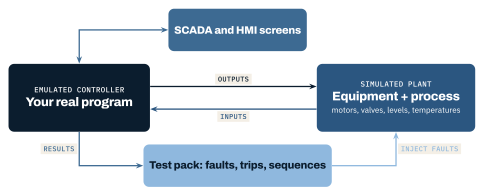
What we do
Use it on a new system before factory acceptance, or on a running plant to prove a change before it is downloaded.
Your PLC program runs unchanged in an emulated controller (for Siemens S7-1500, PLCSIM Advanced) on our test systems, so we test the code that will run on site.
Industries: Agriculture, Automotive, Baggage Handling, Warehousing
Inputs are driven and equipment responds: motors run, valves move, levels and temperatures change. Process models close the loop with your controllers.
Industries: Agriculture, Baggage Handling, Building Services, Chemicals, Food and Beverage, Heat Treatment, Metals, Warehousing, Wastewater
Operator screens, alarms, trends and commands are connected to the emulated controller and tested end to end, before any panel is built.
Normal runs, holds, aborts, restarts, failed sensors and tripped drives, each tested against the functional specification and recorded.
Industries: Aerospace, Airports, Automotive, Chemicals, Clean Water, Food and Beverage, Heat Treatment, Mining and Quarrying, Oil and Gas, Pharmaceutical, Power
A copy of the program that runs today is simulated, so a modification is proven against it before it goes anywhere near your plant.
Industries: Airports, Building Services, Clean Water, Metals, Mining and Quarrying, Nuclear, Oil and Gas, Power, Rail, Wastewater
Your engineers can witness tests on the simulation before factory acceptance, and operators can see the new screens before go-live.
Industries: Aerospace, Nuclear, Pharmaceutical, Rail
Virtual commissioning sits between design and factory acceptance. It catches most logic and interface errors early, so factory and site acceptance can concentrate on what only real equipment can show: wiring, instruments, mechanics and the process itself.
Industries
An ISO 9001 certified quality system, designing to the standards your sector demands, plus any you specify.
Our promise
How we deliver
Virtual commissioning is planned from the start of the project, so the simulation is ready when the code is.
The I/O list, process description and equipment behaviour turned into a model of your plant.
The program loaded into the emulated controller and connected to the simulated I/O and SCADA.
Sequences, interlocks, alarms and faults tested against the functional specification and recorded.
Your engineers witness the tests on the simulation; changes made and retested.
Factory acceptance focused on hardware and integration, with the logic already proven.
Site acceptance on the real equipment, with a shorter, calmer commissioning.
In full
The same tests are run either way. The difference is where they run, and what happens when one fails.
The program meets the plant for the first time at installation.
The program is proven against a simulated plant first.
| Part of the system | How it is simulated | What it proves |
|---|---|---|
| Controller | Your PLC program in an emulated controller, configured like the real one | The code that will run on site |
| Inputs and outputs | Simulated signals with realistic feedback: run signals, valve limits, levels | I/O handling and equipment logic |
| Process | Models of levels, flows, temperatures and pressures, closed loop with your controllers | Control loops and process sequences |
| Operator interface | SCADA and HMI connected to the emulated controller | Screens, alarms, trends and commands |
| Communications | OPC UA and controller links to the simulated system | Data exchange and addressing |
| Faults | Failed sensors, tripped drives, lost communications and out-of-range values, injected on demand | Fault handling and recovery |
| Safety logic | Safety functions exercised in simulation to find errors early | Logic only; safety acceptance is on real equipment |
Project copies prepared, loaded and run in PLCSIM Advanced without manual steps.
Drives simulated inputs, logs every value it forces and releases them all at the end.
Closed-loop models of the process, running with your control loops.
Generated from the PLC program; it can only write to a simulated controller.
Sequence and interlock tests written as tables, traced to the functional specification.
Program, model and test results kept together, so every test can be rerun.
FAQ
No. It comes before them, so they can focus on the real equipment and the process.
Yes. A copy of the program that runs today is simulated, so a change is proven before it is downloaded.
No. The simulation models how equipment and process behave, which is what the control program needs.
Contact
Standards-led, fully documented control systems that you own and can support.