Upgrades • Modifications • Integration

Old controls.
New life.

Upgrade PLCs, SCADA and functions without stopping the plant you depend on.

Sound familiar?

Your plant has outgrown its controls

Most plants run on control systems older than the people who now maintain them. Spares get harder to find, the code is hard to follow, and every new machine or process change has to be squeezed into a system never designed for it. Replacing everything at once is rarely affordable, and production cannot stop for long.

The problemSpares you can't buy
The fixMove to supported kitS7-300 and S7-400 to S7-1500, STEP 7 to TIA Portal, and more.
The problemNobody knows the code
The fixWe map it firstI/O, alarms and sequences recovered before anything changes.
The problemNo time to stop
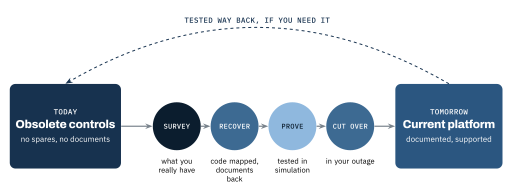
The fixPhased cut-oversPlanned around your outages, with a tested way back.
The problemNew kit won't talk
The fixOne integrated plantDrives, robots, instruments and vision working as one.

How it works

From obsolete to supported, one safe step at a time

We start by finding out what you really have: hardware, versions, code and documents. Then we plan the upgrade around your production: what to replace, what to keep, and in which outage. Existing logic is analysed and carried across, not guessed at; new functions and equipment are engineered in, and every change is tested before it reaches site.

From obsolete to supported, one safe step at a time

What we do

The upgrades we deliver

From a single new function to a complete control system replacement, on existing plant or new, across every discipline that meets the control system.

Upgrade 02

Software and firmware upgrades

Engineering projects, firmware and SCADA brought up to supported versions, such as older TIA Portal projects to the current release, with every version archived and under version control.

Industries: Nuclear, Pharmaceutical

Upgrade 03

HMI and SCADA modernisation

End-of-life operator panels and SCADA replaced. Screens, alarms, trends and scripts are carried across and tested against the PLC before the old system is switched off.

Industries: Airports, Building Services, Clean Water, Power, Rail, Wastewater

Phased upgrades

It does not have to happen all at once

Many upgrades are best done in stages: SCADA first, then controllers line by line, then new functions. We plan the stages with you so that each one leaves the plant fully working and documented, and the next one is ready to start.

Industries

Industries we do this for

An ISO 9001 certified quality system, designing to the standards your sector demands, plus any you specify.

Water and utilities
Process
Manufacturing
Transport and logistics
Buildings and nuclear

How we deliver

From survey to supported system

Every upgrade follows the same path, whether it is one new function or a whole plant.

  1. Survey

    Hardware, versions, code and documents recorded; a backup of what runs today taken and proven restorable.

  2. Recover

    Existing code analysed, and the I/O list, alarm list and functional description recovered from it.

  3. Plan

    Upgrade path, stages, outage windows, cut-over and rollback agreed with you.

  4. Engineer

    Code converted or written, new equipment and functions engineered in, to your standards.

  5. Prove

    Tested against a simulated plant and the old system's behaviour, then factory acceptance.

  6. Cut over

    Installed in your outage, commissioned and site tested, then supported for the long term.

In full

The detail

Upgrade what you have, or add something new

Most projects do both: an existing system is modernised while new equipment is added to it. Each side needs a different kind of care.

Upgrading an existing system

Production depends on it. We change it without losing what it does today.

  • Survey of hardware, firmware and software versions
  • A restorable backup of what runs today, before any change
  • Code analysed and the missing documents recovered from it
  • New system tested against the old system's behaviour
  • Cut-over and rollback plan built around your outages

Adding new equipment or systems

New machines and packages arrive from many suppliers. We make them work as one plant.

  • Interfaces agreed with each supplier before design
  • Signals, limits and failure positions documented
  • One standard for code, screens and alarms across the plant
  • Interfaces tested in simulation before equipment arrives
  • Integrated testing at factory and site acceptance
Integration across the plant
DisciplineWhat we integrateHow it is proven
ProcessControl philosophy, loops, sequences and recipes, agreed with your process engineersSequence tests and process trials
MechanicalPumps, valves, conveyors, guards and pressure systems: signals, limits and failure positionsInterface and failure-position tests
InstrumentationTransmitters, analysers, flow, weighing and level: ranges, scaling, alarms and tripsLoop checks and calibration records
Drives and motionVariable speed drives, servos and motion over fieldbus, with parameters archivedDrive tests and parameter record
Vision and robotsCamera inspection and robot cells: triggers, results, rejects and recipes exchanged with the PLCHandshake and reject tests
SafetyEmergency stops, guarding, safety PLCs and relays, to your safety requirementsSafety requirements tests, independently reviewed
Networks and dataPROFINET, EtherNet/IP, Modbus and OPC UA; links to historians, MES and ERP; segmented networksCommunications tests and network records
How our toolchain de-risks an upgrade
Archive intake

Older TIA Portal archives opened, upgraded to the current release and exported for review.

Code conversion

STEP 7 Classic statement list converted for S7-1500, with every rewrite marked for review.

Code analysis

Maps blocks, sequences, I/O and alarms, and flags faults before anything changes.

Document recovery

I/O, alarm and cause-and-effect lists produced from the code itself.

Simulation

The upgraded program run in PLCSIM Advanced with simulated inputs before site.

Version control

Every version and change kept, so you can see exactly what changed and why.

How we prove it, and where the line is
  • Nothing changes on your running plant without a restorable backup of what runs today
  • Converted code reviewed line by line, and tested against the old system's behaviour
  • Every change staged from offline to simulation to live, each step signed off by a named engineer
  • A cut-over and rollback plan agreed before the outage starts
  • Deviations logged with their fix and retest; nothing closed silently
Nothing changes on your running plant without your permit to work, a restorable backup and sign-off at each stage. Converted code is a starting point that we review and test, not proof of identical behaviour. Equipment supplied by others is proven by its suppliers; we prove the interfaces.
An upgraded system you can support
  • Survey and asset and version inventory
  • Upgrade plan with stages and outages
  • Cut-over and rollback plan
  • Functional design specification
  • I/O list and cause-and-effect
  • FAT and SAT protocols and records
  • As-built drawings and source code
  • Backup and restore arrangement
  • Training and fault method statements

FAQ

Quick answers

Do we have to replace everything?

No. We can upgrade in stages, keep what works, and plan each stage around your production.

We have no documentation. Is that a problem?

No. We recover the I/O list, alarm list and a functional description from the code before we change it.

What if something goes wrong on the day?

Every cut-over has a rollback plan and a proven backup, so the old system can be restored.

Contact

Talk to us about your upgrade

Standards-led, fully documented control systems that you own and can support.